This year I've started attending to a botanical illustration lectures at CIBP - Centro de Ilustração Botânica do Paraná. I feels really good to dedicate my self to the use of natural media again.
The first semester was devoted to the use of pencil and black ink.
Showing posts with label 2d. Show all posts
Tuesday, September 23, 2014
Wednesday, May 15, 2013
Human organs - Heart and liver texture painting
After the modeling and sculpting, I painted the textures for the heart and liver. The textures on the lungs, stomach and intestines are just procedural textures that I just made up for this rendering.
Actually in the final animation, only the liver will be visible as a normal shading mode, the other organs will be rendered with transparencies. This project is about the life cycle of Malaria in the human body and in the mosquito. So in this case, with the semi-transparent organs, the camera will be showing the Malaria parasite flowing through the circulatory system into the liver.
Monday, May 6, 2013
Turma Cósmica - Online multiplayer games.
To finalize the production of the Turma Cósmica series, I'd like to present some details on the latest games that we produced.
Although they are only mini-games, they can be considered as the latest technology for us at the time. Instead of a physical media these are all played online on a web browser using Unity 3D engine and are multiplayer. For modeling and animation we used Blender, a free opensource graphics software. Many of the textures were painted in Blender as well and finalized in Photoshop.
Actually the test was for trying out if I could just model some basic building blocks and make many different tracks from these. Who knows? Maybe even a procedural build track, that a new one could be generated on every game play?
Although they are only mini-games, they can be considered as the latest technology for us at the time. Instead of a physical media these are all played online on a web browser using Unity 3D engine and are multiplayer. For modeling and animation we used Blender, a free opensource graphics software. Many of the textures were painted in Blender as well and finalized in Photoshop.
Next, are some concepts I made before the actual production.
First, I was just exploring the concept of a 3D board game, how it would look like in perspective, trying to find out problems that I could face later on like confused path, or things hidden form the viewer. I had to always keep in mind that these were for young children.
Next I was looking for how much I could push complexity on the path and amount of "houses" (landing places) for the board. My intention was to also use dices, because that is also part of the math subject that the student would be learning in class at this period. At this stage you can also see that I started to use some type of color identification on each house. These would represent the type of question the student would be asked.
So here is how the challenge would be presented. Instead of just adding up (math) the amount acquired of the 3 dices, the student would chose the sequence he would use the 3 dices. For example, the student threw the dices and got 3,2 and 2. If he has more ability in sciences, the could chose to use first one of the dices that had the value of 2 if that will help him to land on a house that is represented by the color of sciences. Later he can chose if it will use the dice of 2 again or the 3 and so on. So there is also strategy that will be used during the game play. On the final version of the game, there were also black colored houses that would be a surprise subject.
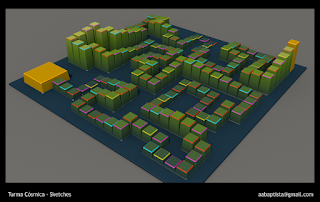
On the following image I represented the final look and feel of the game. You can see I chose the theme and the color pallet. Sketches like these were not supposed to look exactly like the final game just a general idea. Since I did at least 10 different variations of these in one day, not much care was used in the perspective or texture details, they should be done really fast. The first two images above were done in Blender, although it is a 3D software, it is amazingly fast to model, so for just basic layout, trying out different points of view it is a indispensable tool.
These sketches now are for the sand tracks race. Since these were all 3d games, I used Blender again to try out how the track would look in a perspective, its width, how the user would perceive it all.
This sketch I called something like high tech track, who knows, maybe this classic game here in Brazil should look more futuristic... how would kids from the future play this on a Space Station ? Maybe they could even have Storm Troopers uniforms for school? :-)
Actually the test was for trying out if I could just model some basic building blocks and make many different tracks from these. Who knows? Maybe even a procedural build track, that a new one could be generated on every game play?
Then I got melodramatic and decided to go back to the old sand box style track. Remember, the time to get crazy idea is now, when you're just doing concepts. It is better to try something silly and then give up on it now than later on the production process when there is not a whole team working in it. Specially if there are programmers involved, they hate changes :-).
Now I went to sketches in Photoshop where I'm starting to define color pallets and some basic GUI (graphical user interface ) layout.
The more refined and revised GUI layout. You can see on this one that I had also checked to see how the GUI would adjust to different screen aspect ratios, that is what the subtle darker bands are for on each side of the image. The smaller area is a 4:3 (letter box) aspect ratio found on older TVs and computer monitors and the wider one is 16:9 (HD video standard) found on more modern LCD monitors or some smart phones and tablets.
Sunday, April 28, 2013
Turma Cósmica Portal
The final part of the Turma Cósmica Project (loosely translated as Cosmic Bunch), was the development of the educational portal.
The idea is an aggregation center of educational content with a system backbone that can be either used as a web portal or integrated to a school intranet / extranet.
The system has three different profiles:
- student / child login
- parent / teacher login
- administrator login
The screens below are a view of the student / child login.
For the stundent / child profile, the feeling of the portal is of a social network, but great care was taken to guarantee the safety of the youngsters.
First the parent or teacher is the one responsible for creating the account of the young ones, that could be either a father creating the account his children or a teacher creating a new class. If is for a public portal, nicknames can be used for these.
Instead of uploading pictures, the children are only allowed to create and customize their own avatars, choosing gender, physical characteristics, clothing and accessories and a background set.
Another part of this profile is a "News" center where the children receive and send news from their contacts and can also interact with each other making comments on these news. On a school environment, news from the school or teacher can also be received and commented.
Parents and teachers can access and monitor logs of all the students activities throughout the whole system. Messages sent and received or time of login and logout.
Another tool used by the children is the Agenda, they can write down about home works, exams or any other school activity. The teacher can also write a note on each of their respective student, for example "Don't forget to bring your coloring pencils for school tomorrow."
On a environment outside the school a children could use the agenda as a diary or a calendar to mark birthdays.
Probably the most used area by the children is the games area. All the educational games that were once produced for the Turma Cósmica in the past and previously distributed in physical media format now are rewritten for the web using Unity 3d Game Engine. May aspects of the game play is logged for the teachers to follow what games each student likes the most or has the highest scores. Since they are all base on the school curriculum, an analysis can be made to spot overall difficulties in the given subject for each student or the whole class in general.
There is also a trophy system on the games, so each child can see a raking of the best players on his class or social circle.
Accompanying each game, there is also it's corresponding text to the game's subject. New content can added or available one can be edited by a teacher or administrator in this area.
Besides producing the graphics for the games, I also made the graphic design and was part of the over all concept team.
Labels:
2d,
e-learning,
photoshop,
portal,
turma cósmica,
web design,
webpage
Saturday, April 27, 2013
Turma Cósmica volumes 3 and 4
Before writing in-depth about my current works, I'd like to post here some images from our last two games that were produced for Windows and Linux (under wine).
Turma Cósimica Vol. 3
- Rumo ao planeta Antiqua -
(Heading to planet Antiqua)
Trailer
Turma Cósimica Vol. 4
- Reconquistando o Brasil -
(Reconquering Brazil)
Trailer and Game Play
These games were produced almost 4 years ago with Torque Game Engine. The 2D elements were done in Adobe Photoshop and the 3D was done in Autodesk 3DS Max.
Another tool that I used indirectly on Volume 4 was Adobe Flash. I did many animated concepts, game play development and even some coding in Action Script and presented them to the programming team to be implemented in Torque.
Since hardware and software progresses at an amazing rate, the game play and graphics quality in these games are a bit outdated already specially Volume 3, but I still consider them to be of great value to be used in schools or at home following the same curriculum used in a normal class room. These two games were developed for kids in 3rd and 4th grades.
Monday, March 26, 2012
Mouth shapes study.
These are some mouths shapes studies I did for a mockup introductory alphabet lessons for preschool kids. They are supposed to show the differences between vows and consonants. Where, in the vows pronunciation, the air flows out from the mouth without any obstruction.
While consonants, when pronounced are obstructed by lips, tongue or teeth.
Labels:
2d,
3d,
animated gif,
animation,
blender,
character,
mouth shapes
Subscribe to:
Posts (Atom)


